My brother in-law (Mean Gene) just asked me..."Is that rhuizobium bacteria any good for just the garden. Not growing green manure?
Yes it's good to Inoculate your Legumes (Beans and peas) that your harvesting. The strain that I used was specific to my cover crop but you can get a (Garden Combination Mix) that you can us on all beans, peas and grasses and you only need to do it once. Once they are in the soil they will always be there year after year.
Treats up to 8 lbs. Treats Soil Builder Mix, Legume Oat Mixes, vetch (except crown vetch), fava beans, bell beans, crotolaria, garden beans, peas, lentils, lima beans, cowpeas, and peanut. Also known by the brand name N-Dure. I got ours from http://www.groworganic.com/item_ISE350_Garden_Combination_Mix_Inoculant.html#
.
Friday, August 13, 2010

Wednesday, August 11, 2010
Our Garden
April 4 2010
Our first full on Florida year round garden is underway and it's going to be a big learning experience for the two of us.

We rented a tiller for the day that was a huge help... It was all tilled in four hrs.
See the little furry creature? She's the culprit. Already checking out fresh dirt to bury "things"!


We put up a small fence to keep Frito and Tia out so Tia won't bury her toys and so they don't track the dirt from the garden into are house through their doggie door.

Where's WALDO? (smile)

April 11 2010
The build

Clamping is the key to get the boards to seat... clamps are your extra strong hands to get the nasty bows and twists out of your non-hand picked lumber., Predrilled and counter sunk, glued then used 3" (Grip Rite Exterior screws that won't rust) lumber together for longer lasting boxes.


The Tyvek House Wrap (white) and 6 Mill plastic (Black) I used for a moisture barrier for the wood and to keep the chemicals from the pressure treated lumber away from our veggies.


The raised beds are 4'x12' by 15" high and are running east/west. That way we can plant the tallest crop in the north box and then work our way down in size then have the shortest crop in the south box so they all will get full sun.

Main Valve,
The main water feed system for the boxes are valved so we can water with four diffrent methods.
1. Auto timed pumped well water (high PSI).
2. Free flowing well (low PSI)
3. City water (via garden hose connetion)
4. Rain Barrals (low PSI)

Box Valves
Each box is valved at each end so I can control the amount of water they receive.

All plants with be watered by soaker hose so they don't get hit with the sprinklers and the water will go straight to the root system.

July 11 2010
We are ready to plant our cover crop. A cover crop that you grow to maturity then till plant and all right back into the soil (Green Manure) which will be (Sunn Hump) Hoooo Whoooo!!!!

Sunn Hemp:
"A Cover Crop for Southern and
Tropical Farming Systems
Introduction
Do you want a cover crop that will increase organic matter, provide
nitrogen, grow in low fertility sandy soils, and does not harbor nematodes?
Sunn hemp (Crotalaria juncea L.) is a legume that when grown as a summer
annual can produce over 5,000 pounds of biomass and over 100 pounds of
nitrogen per acre. Farmers only need 8 to 12 weeks of frost-free growth
conditions to receive these results.
Using a winter cover crop/green manure is a conservation practice that
provides soil-improving characteristics. A common problem however, is that
the relatively short period between cash crop harvest in the fall and planting
the following spring can result in less than optimum biomass production of the
cover crop. Sunn hemp, because of its rapid growth and relatively short
growing season requirement, can be an excellent alternative. Where conditions
are favorable, it can provide the benefits of a winter legume prior to a killing
frost in the fall and also in the summer after the winter crop has been
harvested."

Inoculant:
Befor I planted the seeds I inoculated them with a RHIZOBIUM BACTERIA which is..."BIOLOGICAL NITROGEN FIXATION
RHIZOBIUM BACTERIA FOR NITROGEN FIXATION & NODULE FORMATION
Of all the mineral nutrients in the soil, nitrogen is generally the most difficult for plants to acquire. Even though nitrogen is the most abundant element in the atmosphere, plants alone, do not have the ability to obtain (fix) it. Only plants, that form a symbiotic relationship with nitrogen fixing bacteria i.e. rhizobia, gram-negative bacilli that invaded the roots of plants, can fix atmospheric nitrogen.
Biological nitrogen fixation is an important factor in any sustainable agriculture program. Biological nitrogen fixation is a process in which nitrogen is taken from its relatively inert molecular form (N2) in the atmosphere and converted into nitrogen compounds useful for building plant protein.
The best known nitrogen fixing plants are legumes i.e. clover which contain symbiotic rhizobia bacteria within nodules in their root systems, producing nitrogen compounds that help to fertilize the soil. The great majority of legumes have this association, but a few genera (e.g. Styphnolobium) do not.
A few dollars worth of rhizobia inoculant can replace hundreds of dollars worth of nitrogen fertilizer and significantly improve soil and crop health."

July 14 2010
Three days after planting and they are up!!! (Smile)

July 18
One week

July 25
Two weeks

These are our compost berrals. The one on the left has been cooking for two months and every two weeks I dump it out on the drive way, stir it, load it back into the can then water it.In this one it will take 5-6 months for useable compost. The one the right is MUCH easier and faster!!! It's a tumbler that I got from one of my customers for free (BIG SMILE) she said that she had it for two years and never used it so she gave it to me. This one we should have useable compost in two months after starting.
Compost mix ratio should be 30 parts Carbon (brown) to one part Nitrogen (green).
"Materials High in Carbon C/N*
autumn leaves 30-80:1
straw 40-100:1
wood chips or sawdust 100-500:1
bark 100-130:1
mixed paper 150-200:1
newspaper or corrugated cardboard 560:1
___________________________________________
Materials High in Nitrogen C:N*
vegetable scraps 15-20:1
coffee grounds 20:1
grass clippings 15-25:1
manure 5-25:1"

Aug 1
Three weeks
31" tall @ 21 days= Just under 1 1/2" per day... We can watch it grow.

This is a photo of the RHIZOBIUM BACTERIA it's the small round egg like looking nodules attached to the roots after three weeks.

Aug 8 2010
Four weeks


The RHIZOBIUM BACTERIA after four weeks.

The 18th I'm going to cut it down. Its a week and a half early but it still will do it's job.
Then let it sit on the ground for three days before I turn it into the soil.
I'll let the boxes sit for three weeks then plant away! We will be planting at the perfect time (second week of Sept) for a fall/winter crop.
Our fall crop lay out

A few are testers just to see how they grow.
Beans
Beets
Broccoli
Red cabbage
Reg Cabbage
Carrots
Collards
leeks
lettuce
GreenOnion
Peppers. Pablano/Ancho, Anaheim, Sweet Bannana and Jalapeno.
Snap peas
Squash
Radish
Rutabaga
Spinach
Wild Strawberry
Tomato
Turnip
Watermelon
Zucchini
We will be Planting most of these in Mid Sept but we'll start the Watermelon inside next week.
Aug 14 2010
I started the Bean, Pea and Cucumber Trellis and also the round beds for the Melons and Squash.

The trellises will be 16' long by 7' height with PVC sleeved cement footing that are 18" deep to hold the trellis in place.

I drilled out the 2"x2"x8' pressure treated so the 3/4" EMT posts will slide through the holes.


I used two of my predilled cross pieces and five 12" peace of EMT to hold the sleeves in place while I cemented them in.

The female inspector came to make sure the footing where dug per code.

And she gave me a pass.

So with her ok I mixed the concrete mix and filled the holes leveling the sleeves as I went.

Now I just need to wait untill the cement to harden.

While the cement is setting I moved on to our Melon/Squash round beds.


Glued and screwed ends.

Dug out the centers 10" then added bagged Garden Soil Mix and bagged Cow Poo with some of the native soil then filled.


Aug 15 2010
The Sunn Hemp at 5 week old and its 57" tall... Three more days and its getting cut down.

Ok back to the trellis... I drilled pilot hole for the Jute cord attaching screws.

The screws are 6" apart so I will have 30 guide lines total... One pre plant.


LOL My neighbor asked me from the other side of the fence..."Cool... Are you making a Dream Catcher or somthun? LOL Then I told her it was a Trellis for beans to climb on... I got that look and a "Huh"? LOL


Aug 18 2010
The Sunn Hemp is 60" tall and is coming down...
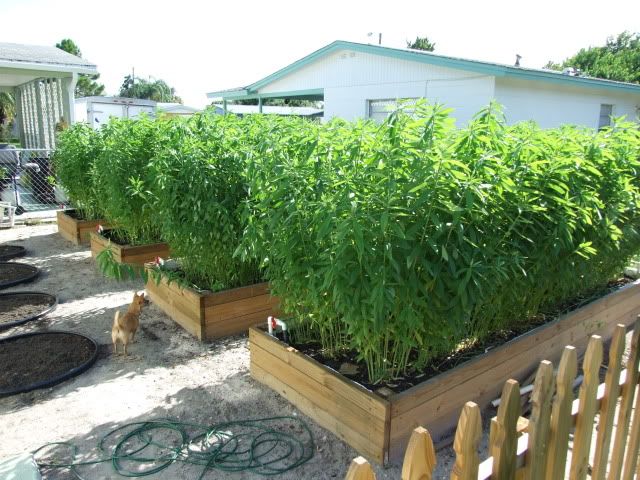
I ended up using the hedge trimmers and they worked great!. I started at the top and worked my way down 5" at a time.
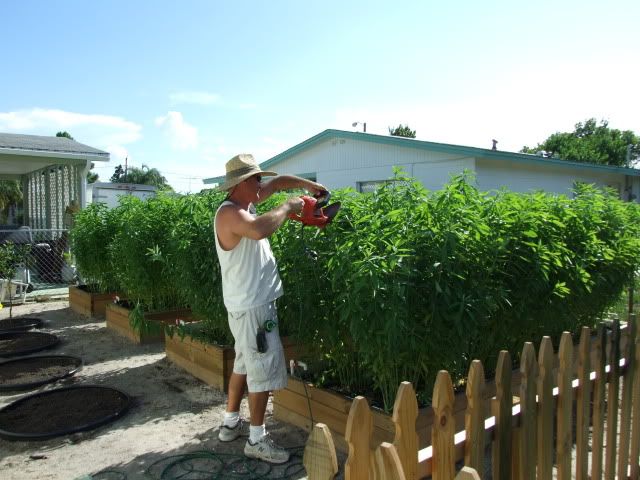
In 10 min per box they were down.
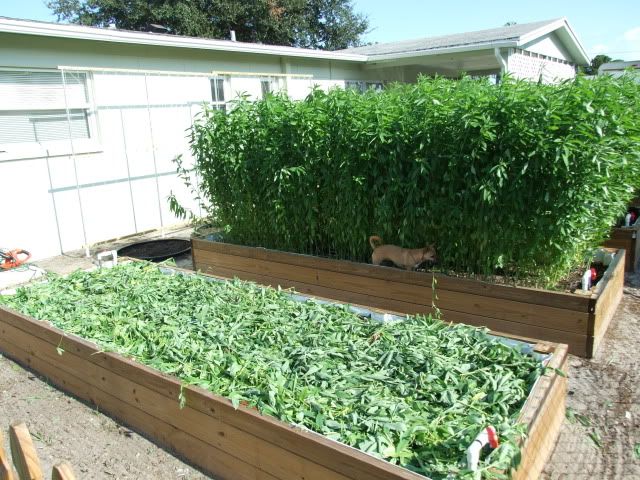
As you can see... The inspector was back to Blue Stake for soaker hoses and to make sure they are ready to come down.

Now I'll let them set in the boxes so they will wilt for three days... then I'll turn them under.
Aug 26
I was trying to figure out the best way to irrigate our melon/squash rounds, my first thoughts where to use drips until this idea hit me one night laying in bed...
Soaker hose with hose barbed tee.


Then used a funny pipe feed line.


Voila!!!

Then the Inspector showed up for the wet test and gave me the ok to bury.

Aug 28
Some of the problems that I have had with growing Tomato's in the past have been...
Blossom End Rot... Caused by a calcum deficiency... Solved. Last crop there was no end rot by using powdered egg shells placed around the plant. I used my coffee grinder to turn our spent egg shells into powder.
Hornworm... that was a HUGE apatite for tomato's leaves... Solved by a weekly inspection of the under side of the leaves for a single small yellowish clear egg left by the Hummingbird Moth at night and by looking for that rotten hatched green Hornworm bugger. When found a good squish is all it takes.
Birds... that take one beak full then leave it for the ants to get into. Solved by Bird netting.
Cracked skins... From irregular watering due to the water that falls from the sky. Solution I hope is... Plastic Mulch.

The one I bought is 4' wide and its only for the Tomato box.


We are all ready to Plant Tomarrow!!!! WOOOOO HOOOOOO!!!! YES WE ARE VERY READY... We are planting two weeks earlier than we planned!
Aug 29
We planted...
Julies notes... While we followed our plan almost exactly, we did make a few changes once we got to planting. Keep in mind, we have resigned ourselves to the fact that this will be a "learning garden" and aren't expecting Bumper Crops. The whole point of this is to see what specific Heirlooms will grow here and what kind of challenges we will face in the future. AND...although I tried to keep the seeds seperated according to planting dates I realized that a couple of varieties got mixed in and were planted a month early. If they don't fruit, we'll try again next month.
All planted in various quantities:
The tubs were purchased for our Sweet Potatoes but I can't order the Slips until next spring...so used them for:
Crystal Wax White Onion
Red Creole Onion
Tendercrisp Celery and Utah Celery
In the beds we have:
Key Lime Lettuce, Buttercrunch Lettuce, Green Romaine Lettuce, Rouge de'Hiver Lettuce, Collard Greens, Bloomsdale Longstanding Spinach, New Zealand Spinach, Atlantic Broccoli, Waltham Broccoli, Late Flat Dutch Cabbage, Red Acre Cabbage, Henderson's Charleston Wakefield Cabbage, Shogoin Turnips, Purple Top Turnips, Laurentian Rutabaga, Purple Top Rutabaga, Carantan Leeks, Evergreen Bunching Onions, Chantenay Royal Carrots, Gold Pak Carrots, Nantes Scarlet Carrots, Detroit Dark Red Beets, Early Wonder Beets, Golden Detroit Beets.
We are late on the Tomatoes and Peppers. I didn't get them started soon enough but I did get a few Hybrid Tomatoes sprouted from seed and Evolver found some plants at Lowe's Saturday along with some Peppers. So, those won't be Heirloom yet but what we've planted is Better Boy and Celebrity from Lowe's and Black from Tula and Yellow Brandywine Tomatoes from seed (that's the bed with the red mulching plastic). And from Lowe's, Ancho's and Bell Peppers. I've also started some new Heirloom Tomatoes and Peppers from seed even though it's a little late. Hopefully the weather will hold out and I can squeeze them in. I've started Lemon Drop Cherry Tomatoes and Matt's Wild Cherry Tomatoes. They are Bush plants and will planted in another box outside this garden area but I've also started First Pick and White Wonder Tomatoes as a back up in case we lose something in the Raised Bed. For the peppers I've started Anaheims, Serrano, Jalapeno, Hot Banana and Hungarian Hot Wax. Can you tell we like our hot peppers?
For the Beans and Peas:
Wando English Peas, Oregon Sugar English Peas, Laxton's Progress English Pea, Sugar Ann Snow Peas, Purple Hull Pinkeye Peas, California Black Eye Peas, Kentucky Wonder (aka Old Homestead) Green Bean, McCaslan Green Bean, Blue Lake Green Bean and Large Speckled Christmas Lima Beans.
In the Circles/Mounds:
Butternut Squash, Table Queen Squash and Sugar Baby Watermelon (occupying one of the circles is my Lemon Tree that has died and come back to life...still not sure if it will ever fruit again. I'll give it one more season and if not I'll replace it.)
There are now two small boxes in front of the A/C unit. This is where we are going to plant some of our "Bee Attractors" and other Pollinator Attractors. But, since I don't have any yet, I used the space for some Radishes since they grow so quickly. I planted Cherry Belle, Sparkler and White Icicle.
The only thing left is to plant the Pointsette and Straight Eight Cucumbers along the chain link fence and whatever I decide to plant along the picket fence. I'm leaning towards Red Malabar Spinach. It's not a true spinach but is an edible ornamental and in some places of Florida can be grown as a Perennial.
This is only a sampling of the variety we have on hand. We have dozens more to try and we'll just keep at it as long as we can and until we find the right plants.
I can't tell you how excited we are! We have been working on this for close to 5 months now and to finally have seeds in the ground is Wonderful!
So now, we just sit, wait, watch and PRAY!


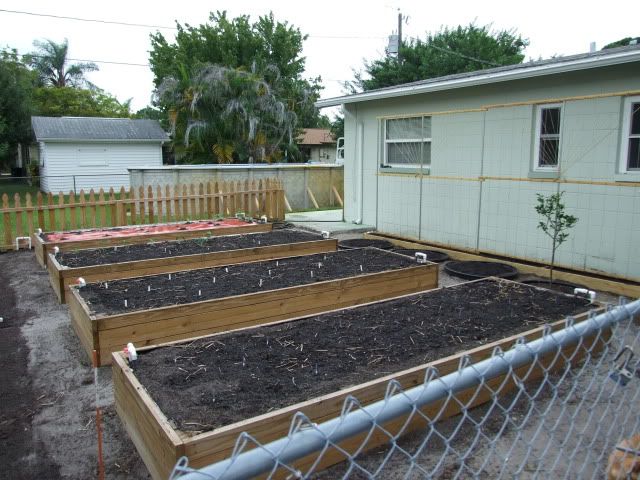
Now the wait for the fruits of our labor!!!
Our first full on Florida year round garden is underway and it's going to be a big learning experience for the two of us.

We rented a tiller for the day that was a huge help... It was all tilled in four hrs.
See the little furry creature? She's the culprit. Already checking out fresh dirt to bury "things"!


We put up a small fence to keep Frito and Tia out so Tia won't bury her toys and so they don't track the dirt from the garden into are house through their doggie door.

Where's WALDO? (smile)

April 11 2010
The build

Clamping is the key to get the boards to seat... clamps are your extra strong hands to get the nasty bows and twists out of your non-hand picked lumber., Predrilled and counter sunk, glued then used 3" (Grip Rite Exterior screws that won't rust) lumber together for longer lasting boxes.


The Tyvek House Wrap (white) and 6 Mill plastic (Black) I used for a moisture barrier for the wood and to keep the chemicals from the pressure treated lumber away from our veggies.


The raised beds are 4'x12' by 15" high and are running east/west. That way we can plant the tallest crop in the north box and then work our way down in size then have the shortest crop in the south box so they all will get full sun.

Main Valve,
The main water feed system for the boxes are valved so we can water with four diffrent methods.
1. Auto timed pumped well water (high PSI).
2. Free flowing well (low PSI)
3. City water (via garden hose connetion)
4. Rain Barrals (low PSI)

Box Valves
Each box is valved at each end so I can control the amount of water they receive.

All plants with be watered by soaker hose so they don't get hit with the sprinklers and the water will go straight to the root system.

July 11 2010
We are ready to plant our cover crop. A cover crop that you grow to maturity then till plant and all right back into the soil (Green Manure) which will be (Sunn Hump) Hoooo Whoooo!!!!

Sunn Hemp:
"A Cover Crop for Southern and
Tropical Farming Systems
Introduction
Do you want a cover crop that will increase organic matter, provide
nitrogen, grow in low fertility sandy soils, and does not harbor nematodes?
Sunn hemp (Crotalaria juncea L.) is a legume that when grown as a summer
annual can produce over 5,000 pounds of biomass and over 100 pounds of
nitrogen per acre. Farmers only need 8 to 12 weeks of frost-free growth
conditions to receive these results.
Using a winter cover crop/green manure is a conservation practice that
provides soil-improving characteristics. A common problem however, is that
the relatively short period between cash crop harvest in the fall and planting
the following spring can result in less than optimum biomass production of the
cover crop. Sunn hemp, because of its rapid growth and relatively short
growing season requirement, can be an excellent alternative. Where conditions
are favorable, it can provide the benefits of a winter legume prior to a killing
frost in the fall and also in the summer after the winter crop has been
harvested."

Inoculant:
Befor I planted the seeds I inoculated them with a RHIZOBIUM BACTERIA which is..."BIOLOGICAL NITROGEN FIXATION
RHIZOBIUM BACTERIA FOR NITROGEN FIXATION & NODULE FORMATION
Of all the mineral nutrients in the soil, nitrogen is generally the most difficult for plants to acquire. Even though nitrogen is the most abundant element in the atmosphere, plants alone, do not have the ability to obtain (fix) it. Only plants, that form a symbiotic relationship with nitrogen fixing bacteria i.e. rhizobia, gram-negative bacilli that invaded the roots of plants, can fix atmospheric nitrogen.
Biological nitrogen fixation is an important factor in any sustainable agriculture program. Biological nitrogen fixation is a process in which nitrogen is taken from its relatively inert molecular form (N2) in the atmosphere and converted into nitrogen compounds useful for building plant protein.
The best known nitrogen fixing plants are legumes i.e. clover which contain symbiotic rhizobia bacteria within nodules in their root systems, producing nitrogen compounds that help to fertilize the soil. The great majority of legumes have this association, but a few genera (e.g. Styphnolobium) do not.
A few dollars worth of rhizobia inoculant can replace hundreds of dollars worth of nitrogen fertilizer and significantly improve soil and crop health."

July 14 2010
Three days after planting and they are up!!! (Smile)

July 18
One week

July 25
Two weeks

These are our compost berrals. The one on the left has been cooking for two months and every two weeks I dump it out on the drive way, stir it, load it back into the can then water it.In this one it will take 5-6 months for useable compost. The one the right is MUCH easier and faster!!! It's a tumbler that I got from one of my customers for free (BIG SMILE) she said that she had it for two years and never used it so she gave it to me. This one we should have useable compost in two months after starting.
Compost mix ratio should be 30 parts Carbon (brown) to one part Nitrogen (green).
"Materials High in Carbon C/N*
autumn leaves 30-80:1
straw 40-100:1
wood chips or sawdust 100-500:1
bark 100-130:1
mixed paper 150-200:1
newspaper or corrugated cardboard 560:1
___________________________________________
Materials High in Nitrogen C:N*
vegetable scraps 15-20:1
coffee grounds 20:1
grass clippings 15-25:1
manure 5-25:1"

Aug 1
Three weeks
31" tall @ 21 days= Just under 1 1/2" per day... We can watch it grow.

This is a photo of the RHIZOBIUM BACTERIA it's the small round egg like looking nodules attached to the roots after three weeks.

Aug 8 2010
Four weeks


The RHIZOBIUM BACTERIA after four weeks.

The 18th I'm going to cut it down. Its a week and a half early but it still will do it's job.
Then let it sit on the ground for three days before I turn it into the soil.
I'll let the boxes sit for three weeks then plant away! We will be planting at the perfect time (second week of Sept) for a fall/winter crop.
Our fall crop lay out

A few are testers just to see how they grow.
Beans
Beets
Broccoli
Red cabbage
Reg Cabbage
Carrots
Collards
leeks
lettuce
GreenOnion
Peppers. Pablano/Ancho, Anaheim, Sweet Bannana and Jalapeno.
Snap peas
Squash
Radish
Rutabaga
Spinach
Wild Strawberry
Tomato
Turnip
Watermelon
Zucchini
We will be Planting most of these in Mid Sept but we'll start the Watermelon inside next week.
Aug 14 2010
I started the Bean, Pea and Cucumber Trellis and also the round beds for the Melons and Squash.

The trellises will be 16' long by 7' height with PVC sleeved cement footing that are 18" deep to hold the trellis in place.

I drilled out the 2"x2"x8' pressure treated so the 3/4" EMT posts will slide through the holes.


I used two of my predilled cross pieces and five 12" peace of EMT to hold the sleeves in place while I cemented them in.

The female inspector came to make sure the footing where dug per code.

And she gave me a pass.

So with her ok I mixed the concrete mix and filled the holes leveling the sleeves as I went.

Now I just need to wait untill the cement to harden.

While the cement is setting I moved on to our Melon/Squash round beds.


Glued and screwed ends.

Dug out the centers 10" then added bagged Garden Soil Mix and bagged Cow Poo with some of the native soil then filled.


Aug 15 2010
The Sunn Hemp at 5 week old and its 57" tall... Three more days and its getting cut down.

Ok back to the trellis... I drilled pilot hole for the Jute cord attaching screws.

The screws are 6" apart so I will have 30 guide lines total... One pre plant.


LOL My neighbor asked me from the other side of the fence..."Cool... Are you making a Dream Catcher or somthun? LOL Then I told her it was a Trellis for beans to climb on... I got that look and a "Huh"? LOL


Aug 18 2010
The Sunn Hemp is 60" tall and is coming down...

I ended up using the hedge trimmers and they worked great!. I started at the top and worked my way down 5" at a time.

In 10 min per box they were down.

As you can see... The inspector was back to Blue Stake for soaker hoses and to make sure they are ready to come down.

Now I'll let them set in the boxes so they will wilt for three days... then I'll turn them under.
Aug 26
I was trying to figure out the best way to irrigate our melon/squash rounds, my first thoughts where to use drips until this idea hit me one night laying in bed...
Soaker hose with hose barbed tee.


Then used a funny pipe feed line.


Voila!!!

Then the Inspector showed up for the wet test and gave me the ok to bury.

Aug 28
Some of the problems that I have had with growing Tomato's in the past have been...
Blossom End Rot... Caused by a calcum deficiency... Solved. Last crop there was no end rot by using powdered egg shells placed around the plant. I used my coffee grinder to turn our spent egg shells into powder.
Hornworm... that was a HUGE apatite for tomato's leaves... Solved by a weekly inspection of the under side of the leaves for a single small yellowish clear egg left by the Hummingbird Moth at night and by looking for that rotten hatched green Hornworm bugger. When found a good squish is all it takes.
Birds... that take one beak full then leave it for the ants to get into. Solved by Bird netting.
Cracked skins... From irregular watering due to the water that falls from the sky. Solution I hope is... Plastic Mulch.

The one I bought is 4' wide and its only for the Tomato box.


We are all ready to Plant Tomarrow!!!! WOOOOO HOOOOOO!!!! YES WE ARE VERY READY... We are planting two weeks earlier than we planned!
Aug 29
We planted...
Julies notes... While we followed our plan almost exactly, we did make a few changes once we got to planting. Keep in mind, we have resigned ourselves to the fact that this will be a "learning garden" and aren't expecting Bumper Crops. The whole point of this is to see what specific Heirlooms will grow here and what kind of challenges we will face in the future. AND...although I tried to keep the seeds seperated according to planting dates I realized that a couple of varieties got mixed in and were planted a month early. If they don't fruit, we'll try again next month.
All planted in various quantities:
The tubs were purchased for our Sweet Potatoes but I can't order the Slips until next spring...so used them for:
Crystal Wax White Onion
Red Creole Onion
Tendercrisp Celery and Utah Celery
In the beds we have:
Key Lime Lettuce, Buttercrunch Lettuce, Green Romaine Lettuce, Rouge de'Hiver Lettuce, Collard Greens, Bloomsdale Longstanding Spinach, New Zealand Spinach, Atlantic Broccoli, Waltham Broccoli, Late Flat Dutch Cabbage, Red Acre Cabbage, Henderson's Charleston Wakefield Cabbage, Shogoin Turnips, Purple Top Turnips, Laurentian Rutabaga, Purple Top Rutabaga, Carantan Leeks, Evergreen Bunching Onions, Chantenay Royal Carrots, Gold Pak Carrots, Nantes Scarlet Carrots, Detroit Dark Red Beets, Early Wonder Beets, Golden Detroit Beets.
We are late on the Tomatoes and Peppers. I didn't get them started soon enough but I did get a few Hybrid Tomatoes sprouted from seed and Evolver found some plants at Lowe's Saturday along with some Peppers. So, those won't be Heirloom yet but what we've planted is Better Boy and Celebrity from Lowe's and Black from Tula and Yellow Brandywine Tomatoes from seed (that's the bed with the red mulching plastic). And from Lowe's, Ancho's and Bell Peppers. I've also started some new Heirloom Tomatoes and Peppers from seed even though it's a little late. Hopefully the weather will hold out and I can squeeze them in. I've started Lemon Drop Cherry Tomatoes and Matt's Wild Cherry Tomatoes. They are Bush plants and will planted in another box outside this garden area but I've also started First Pick and White Wonder Tomatoes as a back up in case we lose something in the Raised Bed. For the peppers I've started Anaheims, Serrano, Jalapeno, Hot Banana and Hungarian Hot Wax. Can you tell we like our hot peppers?
For the Beans and Peas:
Wando English Peas, Oregon Sugar English Peas, Laxton's Progress English Pea, Sugar Ann Snow Peas, Purple Hull Pinkeye Peas, California Black Eye Peas, Kentucky Wonder (aka Old Homestead) Green Bean, McCaslan Green Bean, Blue Lake Green Bean and Large Speckled Christmas Lima Beans.
In the Circles/Mounds:
Butternut Squash, Table Queen Squash and Sugar Baby Watermelon (occupying one of the circles is my Lemon Tree that has died and come back to life...still not sure if it will ever fruit again. I'll give it one more season and if not I'll replace it.)
There are now two small boxes in front of the A/C unit. This is where we are going to plant some of our "Bee Attractors" and other Pollinator Attractors. But, since I don't have any yet, I used the space for some Radishes since they grow so quickly. I planted Cherry Belle, Sparkler and White Icicle.
The only thing left is to plant the Pointsette and Straight Eight Cucumbers along the chain link fence and whatever I decide to plant along the picket fence. I'm leaning towards Red Malabar Spinach. It's not a true spinach but is an edible ornamental and in some places of Florida can be grown as a Perennial.
This is only a sampling of the variety we have on hand. We have dozens more to try and we'll just keep at it as long as we can and until we find the right plants.
I can't tell you how excited we are! We have been working on this for close to 5 months now and to finally have seeds in the ground is Wonderful!
So now, we just sit, wait, watch and PRAY!


Now the wait for the fruits of our labor!!!
Subscribe to:
Posts (Atom)